"I Know That Other Robot, You Can Turn Them Off": Ingroup Robots Elicit Lower Compliance to Instructions that Undermine Another Robot

Abstract
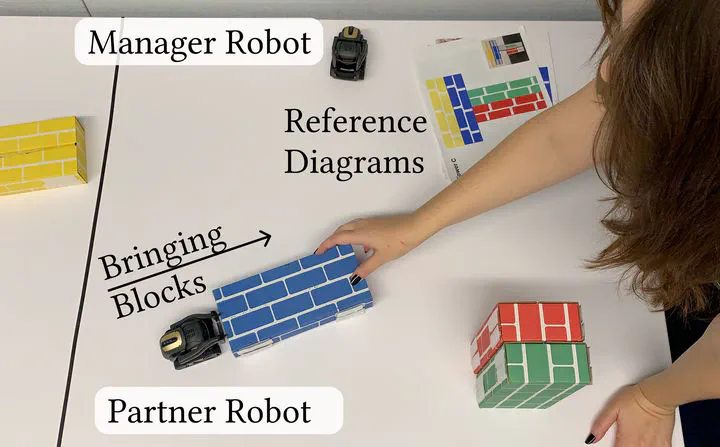
As robots become increasingly capable and widespread, they may be placed into roles where they are responsible for giving people instructions (e.g., directing human coworkers in a warehouse). It is important to better understand the factors that may influence human compliance to robot instructions, given that these instructions may undermine or invalidate the efforts of another person or robot. In this work, we investigate to what extent an established robot-robot relationship will impact a person’s choice to comply with instructions from one robot to undermine another robot’s contributions in a collaborative task. We ran a between-subjects study (N = 50) where participants collaborated with a partner robot to build a series of towers at the direction of a manager robot. These two robots were either presented as an ingroup with a shared history and preferential treatment of one another (ingroup condition) or as an outgroup without shared history and neutral treatment of one another (outgroup condition). During the experiment, the manager robot in both conditions gave the human participant instructions to undermine the efforts of the partner robot. We found that participants in the ingroup condition are significantly less likely to comply with these instructions and also view both robots more positively than those in the outgroup condition. Our results demonstrate that the presence of an ingroup relationship between robots can both lessen compliance with instructions that undermine partnerships and generate a more positive social atmosphere within a human-robot collaboration.
Type
Publication
2025 34th IEEE International Conference on Robot and Human Interactive Communication (RO-MAN)